


Hip Labral Tear Behind “Groin Pain and Impingement” — What Stem Cell Conditioned Media Joint Injection Can Target for FAI-Related Labral Injury: The Inflammation and Repair Layers2026.07.06
A pinching sensation deep in the hip when standing up after a long sit, or a sharp groin pain when starting to walk — behind these symptoms, a hip labral tear associated with FAI (femoroacetabular impingement) may be quietly at work. It is easily dismissed as a simple muscle strain, yet if left alone it can become a precursor to hip osteoarthritis. In this column, from Dr. Moriwaki’s perspective, we outline what stem cell conditioned media joint injection can and cannot target for a hip labral tear.
Key Points of This Article
・Groin pain and a hip impingement sensation may reflect an underlying FAI and hip labral tear.
・A labral injury worsens through two layers: an inflammatory vicious cycle and structural damage of the labrum and cartilage.
・Stem cell conditioned media joint injection may act on inflammation control and on shaping the tissue-repair environment.
・This injection is not a treatment that sutures the torn labrum itself — the premise must be shared honestly.
・Deciding whether arthroscopic surgery is indicated and combining rehabilitation are keys to long-term joint preservation.
What “Impingement and Groin Pain” in the Hip Can Signal
Hip pain is often written off as “just aging,” but FAI and structural labral injury are representative conditions that also affect younger and middle-aged adults.
What is FAI (femoroacetabular impingement)
FAI is a condition in which a bony deformity on the femoral head side (cam type), overcoverage on the acetabular side (pincer type), or a mixture of the two causes the bones to collide during flexion and internal rotation, mechanically injuring the edge of the labrum and articular cartilage. Deep squatting, getting out of a car, or stiffness after prolonged sitting — repetition of such movements accumulates microdamage, and structural injury progresses over time. Because it is not a single traumatic event but a “problem of shape,” the condition tends to become chronic.
How a labral tear leads to pain and functional decline
The labrum is a cartilaginous seal attached to the rim of the acetabulum, and it contributes to joint sealing, stability, and load distribution. When it is damaged, (1) the negative-pressure seal of the joint fluid breaks down and micro-instability increases, (2) inflammatory cytokines from the injury site trigger synovitis, and (3) disturbed load transfer concentrates stress on the subchondral bone — creating a vicious cycle. This is why a hip labral tear often “lingers as symptoms once it develops.”
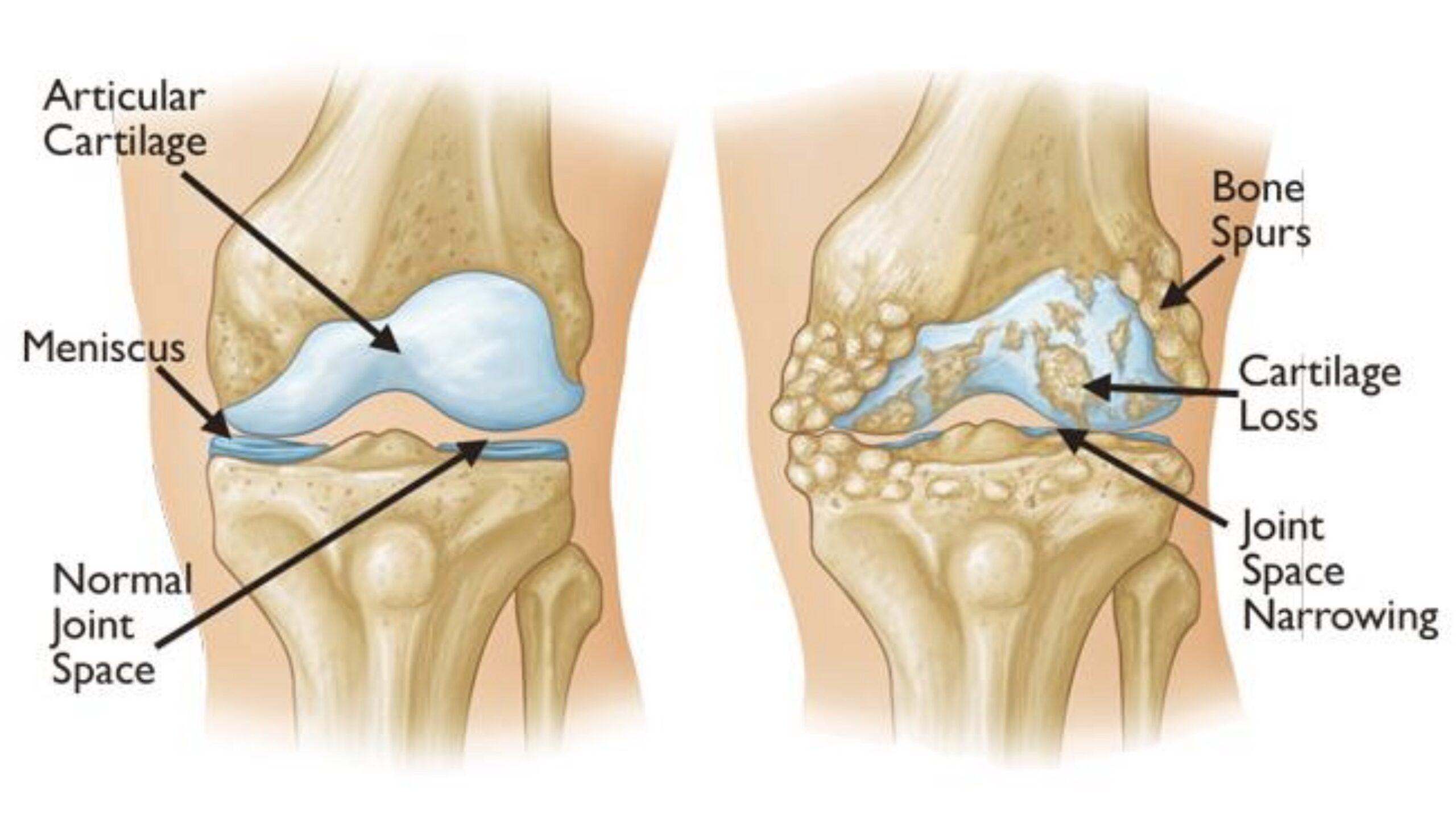
What Stem Cell Conditioned Media Joint Injection Can Target for a Hip Labral Tear
Stem cell conditioned media is a biological preparation collecting the growth factors, cytokines, and exosomes secreted by mesenchymal stem cells. It is not a treatment that transplants the cells themselves; the concept is to deliver a “complex of signals that the cells emit” into the joint cavity.
The inflammation layer: calming synovitis and reshaping the joint-fluid environment
Debris and inflammatory mediators from the injured labrum irritate the synovium, and chronic synovitis sustains pain. TGF-β and IL-1 receptor antagonist-like molecules contained in conditioned media have been reported, in vitro and in animal models, to shift the expression of inflammatory cytokines in a suppressive direction, so reshaping the joint-fluid environment may help ease pain and discomfort. Large comparative human trials remain limited, however, and effects vary between individuals.
The repair layer: signals that may reach the labrum and subchondral bone
Growth factors such as IGF-1, FGF, and VEGF are described as being able to send proliferation, matrix production, and angiogenesis signals to chondrocytes and synovium-derived mesenchymal stem cells. This is not, however, an approach that sutures a torn labrum itself. It is directed at shaping the tissue-repair environment, not at recreating lost tissue anew — this premise must be shared before choosing the treatment. For general orthopedic information, please refer to the Japanese Orthopaedic Association.
How It Fits Alongside Other Options, and Where the Injection Reaches Its Limits
Positioning versus steroids, hyaluronic acid, and surgery (arthroscopic repair)
Steroid joint injection powerfully suppresses inflammation, but repeated use raises concerns about cartilage and tendon burden. Hyaluronic acid has less established evidence in the hip than in the knee, and remains positioned as a viscosupplement. For a large labral tear, bucket-handle-type injury, or severe FAI bony morphology, arthroscopic labral repair and osteochondroplasty often become the first-line option — stem cell conditioned media joint injection should be honestly positioned as one of several conservative options. Please also see our page on stem cell conditioned media joint injection.
When the injection is not suitable for a hip labral tear
(1) Active intra-articular infection, (2) end-stage hip osteoarthritis with femoral head migration, (3) clearly progressive femoral head osteonecrosis, and (4) uncontrolled systemic disease — in these situations, improvement from injection is not expected, or risk outweighs benefit. Even in younger conservative cases, trunk and gluteal strengthening and movement modification (avoiding excessive deep flexion or internal rotation) form the foundation. Rather than trying to solve everything with “injection alone,” combining rehabilitation and redesign of daily movement is what leads to long-term hip preservation.
Frequently Asked Questions
Q. Does a hip labral tear heal on its own?
The labrum has poor blood supply, so once torn, spontaneous restoration to the original state is considered rare. However, adjustment of loading and movement combined with inflammation control can, in some cases, “settle symptoms.” Please understand that structural repair and symptomatic management are different goals.
Q. How is conditioned media injected into the hip?
The hip is deep and hard to reach reliably with surface landmarks alone, so ultrasound-guided or fluoroscopy-guided administration is recommended. Our clinic performs it under ultrasound guidance to ensure precision and safety.
Q. How many sessions are needed before effect can be judged?
This varies with symptom severity and inflammation, but as an induction phase, 2 to 3 sessions at intervals of several weeks are common, with progress evaluated by pain scores and range of motion. If the response is poor at the three-month mark, imaging re-evaluation and reconsideration of surgical options should be discussed.
Q. I am torn between arthroscopic surgery and conditioned media injection. Which first?
When a large labral tear or clearly abnormal FAI bony morphology is present, orthopedic evaluation should come first. If surgical indications are clear, that is the main path — early structural repair may be better for prognosis than delaying with injections. Positioning the injection as an option for intermediate cases who want to persist conservatively is the honest stance.
Q. Are there side effects?
Bleeding, infection, and transient pain flare associated with joint puncture exist just as they do with other joint injections. Our clinic uses quality-controlled sterile preparations, but the possibility of an idiosyncratic hypersensitivity reaction cannot be reduced to zero, so we carefully confirm medical and allergy history before proceeding.
──────────────
Medical supervisor: Shin Moriwaki, MD (supervising physician)
Member, Japan Society of Aesthetic Surgery (JSAS) / Member, American Academy of Aesthetic Medicine
ECFMG certificate holder
──────────────
📍AVAN TOKYO Ginza Regenerative Medicine
AVAN TOKYO Ginza Regenerative Medicine
English / 中文 / Tiếng Việt supported
Inquiries welcome via DM / LINE / Website / Phone.