


Injection Treatments for Knee Pain and Inflammation2026.07.03
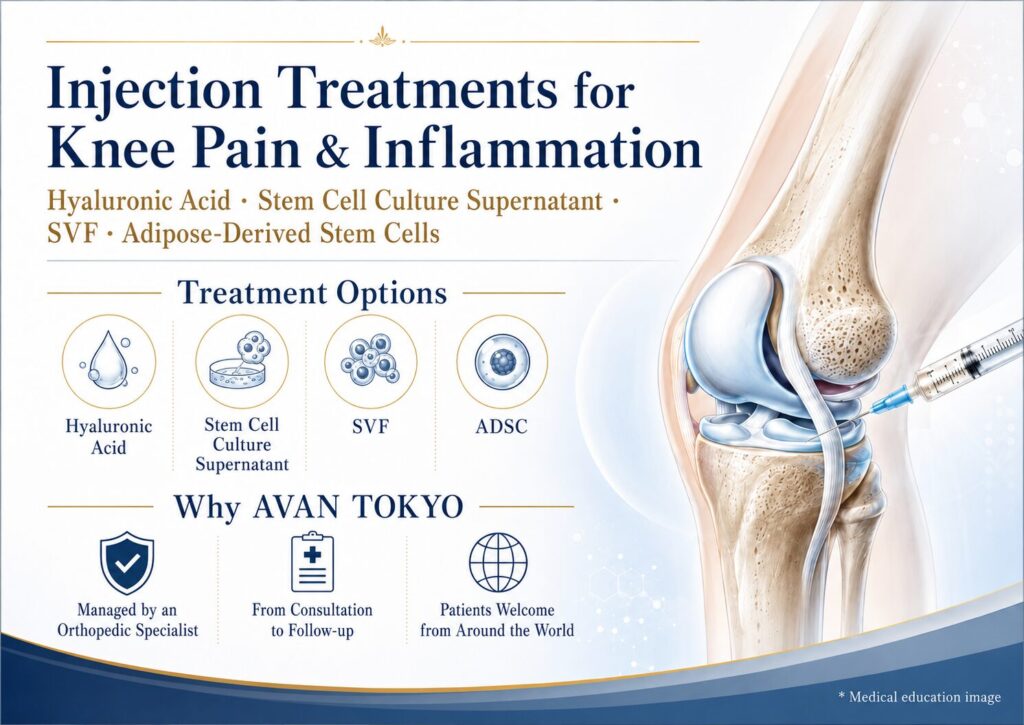
Hyaluronic Acid, Stem Cell Culture Supernatant, SVF, and Adipose-Derived Stem Cell Therapy
Knee pain and inflammation can be caused by aging, sports injuries, weight gain, previous trauma, meniscus degeneration, cartilage wear, and osteoarthritis.
For many years, hyaluronic acid injections have been widely used as a conservative treatment for knee pain. In recent years, regenerative medicine-based treatments such as stem cell culture supernatant, SVF, and adipose-derived stem cell therapy have also gained attention for their potential to help regulate inflammation and support the joint environment.
At AVAN TOKYO, all knee treatments are managed by an orthopedic specialist, from diagnosis and treatment planning to injection procedures and follow-up care.
We welcome patients not only from Japan, but from all over the world.
Knee Pain Is Not Caused Only by Cartilage Wear
Many patients think knee pain is caused only by worn cartilage.
However, knee pain can involve multiple factors, including:
● Synovial inflammation
● Changes in joint fluid
● Meniscus degeneration
● Cartilage damage
● Bone marrow edema
● Muscle weakness
● Knee alignment
● Body weight load
● Previous injuries
● Daily activity habits
Therefore, treatment should not focus only on “regenerating cartilage.” It is important to evaluate the cause of pain, the degree of inflammation, joint condition, lifestyle, and activity level.
Goals of Knee Injection Treatment
Knee injection treatments may aim to:
● Reduce pain
● Control inflammation
● Improve joint lubrication
● Support the intra-articular environment
● Help patients continue rehabilitation and exercise
● Provide a non-surgical treatment option
Injection therapy is not always a substitute for surgery.
In advanced osteoarthritis, surgery such as knee replacement may eventually be required. However, for patients who are not ready for surgery, want to delay surgery, or wish to reduce pain and inflammation while maintaining daily activity, injection therapy may be a useful option.
Hyaluronic Acid Injection
Hyaluronic acid is a natural component of joint fluid.
It helps lubricate the joint and supports smoother knee movement.
In osteoarthritis, the quality of joint fluid may deteriorate, resulting in reduced lubrication and increased inflammation. Hyaluronic acid injections aim to supplement this joint fluid and reduce pain.
Advantages
● Long history of clinical use
● Relatively low burden on the body
● Can be performed quickly as an outpatient procedure
● Minimal downtime
● Often used for mild to moderate knee pain
● Suitable for many elderly patients
Disadvantages
● Results vary between individuals
● May be less effective in advanced osteoarthritis
● Repeated injections may be necessary
● May not be sufficient when inflammation is severe
● Does not directly regenerate cartilage
Suitable For
● Mild to moderate knee pain
● Patients who want to start with a less invasive treatment
● Patients who are not yet considering surgery
● Patients combining treatment with exercise therapy or lifestyle improvement
Stem Cell Culture Supernatant
Stem cell culture supernatant is a solution obtained during the process of culturing stem cells.
It does not contain living stem cells. Instead, it contains bioactive substances secreted by stem cells, such as growth factors, cytokines, and extracellular vesicles.
For knee pain and inflammation, it may be used with the goal of reducing inflammation and improving the joint environment.
Advantages
● No fat harvesting is required
● Performed by injection only
● Short procedure time
● Lower physical burden compared with cell-harvesting procedures
● May be useful for inflammation-focused treatment
Disadvantages
● It is not a living stem cell therapy
● Results vary between individuals
● Has limitations in advanced joint deformity
● Product quality control is important
● Long-term evidence is still developing
Suitable For
● Patients with knee pain and inflammation
● Patients who do not want fat harvesting
● Patients interested in regenerative medicine with a lower treatment burden
● Patients considering options other than hyaluronic acid
SVF Treatment
SVF stands for Stromal Vascular Fraction.
It is a cell population obtained from adipose tissue and contains not only adipose-derived stem/stromal cells, but also vascular endothelial cells, pericytes, immune cells, and other regenerative-related cells.
SVF is not a single type of stem cell. It is a mixed cell population derived from fat tissue.
For knee joints, SVF may be used with the goal of regulating inflammation and supporting the repair environment inside the joint.
Advantages
● Uses the patient’s own fat tissue
● Contains multiple cell components
● May support inflammation regulation and tissue repair environment
● Regenerative medicine approach using adipose tissue
● May be considered for knee pain and functional improvement
Disadvantages
● Requires fat harvesting
● More invasive than hyaluronic acid injection
● Cost may be higher
● Results vary between individuals
● Has limitations in advanced joint destruction
● Requires appropriate regulatory and facility management
Suitable For
● Patients who were not satisfied with hyaluronic acid injections
● Patients who want a more active regenerative medicine option
● Patients seeking non-surgical treatment for knee pain
● Patients interested in using their own fat-derived cells
Adipose-Derived Stem Cell Therapy
Adipose-derived stem cell therapy uses stem/stromal cells obtained from fat tissue.
These cells are expected to have anti-inflammatory and tissue-supportive effects through cell signaling and paracrine mechanisms.
For knee joints, this treatment is being studied and clinically applied for pain relief, inflammation control, and functional support.
Advantages
● Uses the patient’s own fat-derived cells
● May support anti-inflammatory and tissue repair environments
● Considered a more active regenerative medicine option
● May be an option for mild to moderate knee osteoarthritis
Disadvantages
● Requires fat harvesting
● Treatment planning is more complex
● Cost may be higher
● Results vary between individuals
● Not suitable for all types of knee pain
● Long-term outcomes and optimal protocols are still being studied
Suitable For
● Patients looking for an option between conservative treatment and surgery
● Patients interested in regenerative medicine
● Patients who want to maintain activity while managing knee pain
● Patients with mild to moderate osteoarthritis
Comparing the Treatment Options
Hyaluronic Acid
A relatively simple and low-burden treatment.
It is easy to start, but the effect may be limited in advanced osteoarthritis or severe inflammation.
Stem Cell Culture Supernatant
A regenerative medicine-based injection that does not require fat harvesting.
It is mainly used to support inflammation control and improve the joint environment.
SVF
A treatment using a mixed population of cells derived from the patient’s fat tissue.
It requires fat harvesting and is more involved than hyaluronic acid injection.
Adipose-Derived Stem Cell Therapy
A regenerative medicine-based treatment using fat-derived cells.
It requires careful evaluation, cell processing, treatment planning, and proper regulatory management.
Which Treatment Is Best?
There is no single best treatment for every patient.
The most important point is choosing the appropriate treatment based on the condition of the knee.
Even among patients with knee pain, the background may differ:
● Mild osteoarthritis
● Moderate osteoarthritis
● Advanced joint deformity
● Meniscus-dominant pain
● Strong synovial inflammation
● Recurrent knee swelling
● Sports-related knee pain
● Desire to delay surgery
● Short-stay treatment for international patients
At AVAN TOKYO, we evaluate symptoms, imaging findings, physical examination, lifestyle, goals, and travel schedule before proposing a treatment plan.
All Knee Treatments Are Managed by an Orthopedic Specialist
Knee treatment requires a detailed understanding of the joint, cartilage, meniscus, ligaments, muscles, and alignment.
At AVAN TOKYO, all injection treatments for knee pain and inflammation are managed by an orthopedic specialist.
The orthopedic specialist handles:
● Symptom evaluation
● Medical history review
● Imaging assessment
● Knee examination
● Treatment indication
● Injection procedure
● Post-treatment follow-up
Regenerative medicine is not simply “injecting something into the knee.”
It is essential to determine whether the treatment is truly indicated, which option is most appropriate, and whether surgery should be considered instead.
Patients From Around the World Are Welcome
AVAN TOKYO welcomes patients from Japan and overseas.
For international patients, we can arrange online consultations in advance to review symptoms, imaging, medical history, treatment goals, and the length of stay in Japan.
Support may include:
● Online consultation
● English guidance
● Multilingual support when needed
● Review of imaging before travel
● Treatment planning during the stay in Japan
● Post-treatment follow-up
For patients visiting Japan for a short period, we aim to make the treatment process as smooth as possible through careful preparation.
Treatment Flow
- Consultation
We confirm the location of pain, duration of symptoms, swelling, fluid accumulation, pain while walking, stair pain, sports history, and previous injuries. - Imaging Review
If X-rays or MRI images are available, we review them.
For international patients, sharing imaging data before visiting Japan can help us prepare a treatment plan in advance. - Examination by an Orthopedic Specialist
We assess range of motion, swelling, tenderness, ligaments, meniscus signs, muscle strength, and walking condition. - Treatment Selection
Based on the patient’s condition, we propose treatment options such as hyaluronic acid, stem cell culture supernatant, SVF, or adipose-derived stem cell therapy.
Rehabilitation, weight management, muscle training, or surgical options may also be discussed when necessary. - Injection Treatment
The treatment is injected into the knee joint with attention to accuracy and safety.
Ultrasound guidance may be used when appropriate. - Follow-Up
We monitor pain, swelling, range of motion, and daily activity after treatment.
Downtime and Precautions
Downtime depends on the treatment type.
Hyaluronic Acid
Downtime is usually minimal.
Many patients can walk on the same day, but intense exercise or long walking should be avoided immediately after the injection.
Stem Cell Culture Supernatant
Temporary pain, discomfort, or swelling may occur after injection.
Strong knee loading should be avoided for several days.
SVF and Adipose-Derived Stem Cell Therapy
If fat harvesting is required, there will be downtime not only in the knee but also at the fat donor site.
Pain, swelling, bruising, firmness, or scars may occur at the harvesting area.
Intense exercise should be avoided for a period of time according to the doctor’s instructions.
Risks and Side Effects
Possible risks include:
● Pain during injection
● Temporary swelling
● Heat sensation
● Bruising
● Infection
● Intra-articular bleeding
● Allergic reaction
● Temporary worsening of pain
● Limited or insufficient effect
● Symptom recurrence
● Pain at the fat harvesting site
● Swelling or bruising at the fat harvesting site
● Numbness
● Scarring
● Hematoma
● Seroma
Regenerative medicine treatments do not produce the same results in every patient.
In advanced osteoarthritis, injection therapy may not provide enough improvement, and surgical treatment such as knee replacement may be necessary.
Summary
There are several injection treatment options for knee pain and inflammation, including hyaluronic acid, stem cell culture supernatant, SVF, and adipose-derived stem cell therapy.
Each treatment has its own advantages, disadvantages, and indications.
The most important thing is not choosing a treatment simply because it is popular, but selecting the treatment that best matches the condition of the knee.
At AVAN TOKYO, all knee treatments are managed by an orthopedic specialist, from diagnosis and imaging evaluation to injection treatment and follow-up care.
We welcome patients from Japan and from all over the world.
Our goal is to help each patient reduce knee pain, control inflammation, and maintain a more active daily life.
This article is intended for medical education purposes. Results and recovery vary between individuals. Regenerative medicine treatments may be provided as private medical care.