


What Is AGA? A Medical Explanation of the Mechanism Behind Male Pattern Hair Loss2026.04.29
Many people have heard the term AGA, but relatively few understand exactly how it works.
Before resigning yourself to thoughts like “it’s just genetics” or “nothing can be done as you age,” it is important to first understand the medical mechanisms at work.
Accurate knowledge opens the door to better treatment choices — and significantly increases the chances of slowing progression or achieving real improvement.
AGA — What the Acronym Stands For
AGA stands for Androgenetic Alopecia, a form of hair loss driven by the combination of androgens (male sex hormones) and genetic predisposition.
In Japan, approximately one in three men is affected, with onset typically beginning in the 30s and becoming more pronounced in the 40s and 50s.
That said, cases in the 20s are no longer uncommon, making early intervention increasingly important.
One key distinction: AGA is not a disease in the traditional sense, but rather a condition rooted in the interplay of hormones and heredity.
Without appropriate treatment, it does not resolve on its own — and will continue to progress over time.
How DHT (Dihydrotestosterone) Causes Follicle Miniaturization
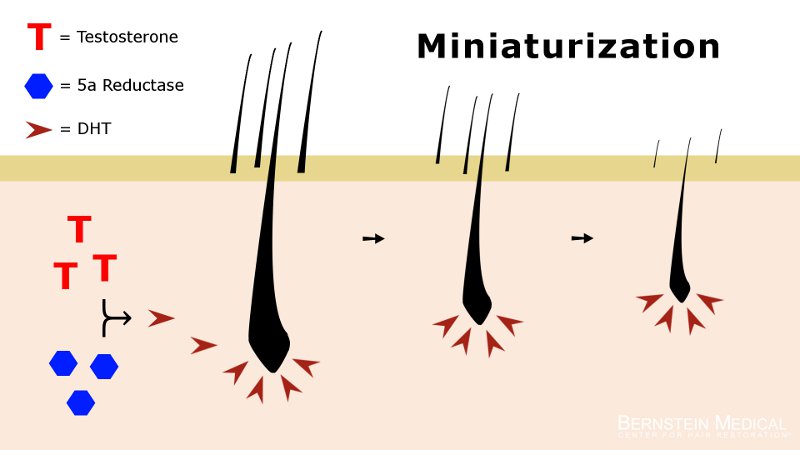
The central mechanism of AGA involves a substance called DHT (dihydrotestosterone) acting on the hair follicles.
Testosterone — the primary male sex hormone — is converted into DHT by an enzyme called 5-alpha reductase, which is present in the scalp.
DHT then binds to androgen receptors in the hair follicles, suppressing the division of hair matrix cells and disrupting the natural hair growth cycle.
Specifically, the “anagen” (growth) phase — which normally lasts two to six years — gradually shortens to just a few months or about a year.
With a shorter growth phase, hair cannot grow sufficiently thick or long, and gradually regresses into fine, short “vellus hair.”
As this follicle miniaturization cycle repeats, the follicle eventually loses its function entirely, and hair stops growing.
The Role of Genetics — AGA Is Inherited From Both Parents
The primary gene associated with AGA is the androgen receptor gene, located on the X chromosome.
Since the X chromosome is inherited from the mother, the idea that “AGA follows the maternal grandfather” has some scientific basis.
However, multiple genes are involved, and paternal inheritance also plays a clear role.
In short, AGA is not as simple as “resembling one parent” — it results from a complex combination of genetic factors from both sides.
Carrying a genetic predisposition does not guarantee development; environmental factors, lifestyle habits, and hormonal balance all play significant roles.
Those with a higher genetic risk have even more reason to begin preventive care early.
How AGA Progresses — The Hamilton-Norwood Classification
AGA progression is commonly evaluated using the seven-stage Hamilton-Norwood Scale.
・Stage I–II: Minor recession of the frontal hairline
・Stage III: Clearly visible hairline recession, with early thinning at the crown
・Stage IV–V: Advancing thinning across the frontal and crown areas, which may merge
・Stage VI–VII: Extensive hair loss across a wide area, with only the rear and sides remaining
The rate of progression varies considerably between individuals — some experience rapid change over a few years, while others progress slowly over decades.
Treatment initiated at Stage III or earlier produces the most favorable long-term outcomes.
How FAGA (Female AGA) Differs
Female pattern hair loss (FAGA) shares the same underlying mechanism as male AGA — DHT involvement — but presents very differently.
While men typically experience recession at the hairline, women more commonly develop diffuse thinning at the crown and along the part line.
Because estrogen helps protect the hair growth cycle, FAGA often becomes apparent after menopause or following childbirth, when hormonal balance shifts.
FAGA remains less recognized than male AGA and is frequently overlooked.
However, many cases respond well to appropriate treatment, which makes early diagnosis and intervention especially important.
AGA Is Progressive — The Risk of Doing Nothing
The defining characteristic of AGA is that it is progressive.
Without appropriate treatment or intervention, thinning will continue to spread over time.
Once complete follicle loss occurs, regenerating those follicles becomes extremely difficult with current medical technology.
Regenerative treatments — including stem cell conditioned medium, exosomes, and Morpheus8 — are designed to reactivate follicles that still retain function and reverse the miniaturization process.
For this reason, beginning treatment while follicles are still present offers the greatest chance of meaningful improvement.
Seeking consultation at the first sign of thinning can make a profound difference in long-term outcomes.
📍AVAN TOKYO Ginza Hair Regeneration Clinic
AVAN TOKYO GINZA HAIR REGENERATION CLINIC
English / 中文 / Tiếng Việt Available
For reservations and consultations:
DM / LINE / Website / Phone