


When Patients on Biologics or Immunosuppressants for Psoriasis or Atopic Dermatitis Consider Stem Cell Conditioned Media Scalp Treatment — Dr. Moriwaki Outlines the Infection-Risk and Timing Safety Margins for Systemic Therapy2026.07.29
In recent years, patients on ongoing systemic therapy with biologics or immunosuppressants for chronic inflammatory conditions such as psoriasis, atopic dermatitis, or rheumatoid arthritis increasingly ask us: “I’d like to receive scalp treatment with stem cell conditioned media — can I stay on my current medication?” Scalp treatment under biologics is not a “just inject it and you’re done” procedure. It has to be built carefully around three axes: immune status, infection risk, and wound healing. In this article, Dr. Shin Moriwaki organizes how we think about this in daily practice.
Key Points
・Scalp treatment under biologics is not universally contraindicated, but the weight of infection risk differs across drug classes — TNFα inhibitors, IL-17 inhibitors, IL-4/13 inhibitors, JAK inhibitors, and conventional immunosuppressants each behave differently.
・The baseline principle is to incorporate the procedure when systemic inflammation of the underlying disease is calm and the dermatology attending judges the current regimen to be stable.
・Any scalp injection or needling procedure creates “small wounds,” and under immunosuppression the earliest possible detection of infection signs is the top priority.
・When psoriasis or atopic lesions on the scalp are themselves active, dermatological control must be re-established first.
・Stem cell conditioned media is not a substitute for biologics — it is treated as a separate axis, addressing scalp environment and follicular care.
Why Scalp Treatment Under Biologics Needs a Separate Framework
The Degree of Immunosuppression Varies Widely by Drug
Biologics and immunosuppressants may sound alike, but their molecular targets and the actual weight of immunosuppression differ substantially. TNFα inhibitors (infliximab, adalimumab, and so on), IL-17 inhibitors (secukinumab, ixekizumab), IL-23 inhibitors, IL-4/13 inhibitors (dupilumab), JAK inhibitors, and conventional agents such as cyclosporine or methotrexate all suppress different pathways. Relative infection risk is not the same either. Dupilumab, for example, is generally regarded as not causing strong systemic immunosuppression, whereas JAK inhibitors are drugs for which clinicians remain alert to reactivation of herpes zoster and herpes simplex. When building scalp treatment under biologics, the starting point is sharing with the primary physician “which drug, for how long, and at what phase” the patient is currently on.
The Reality That This Procedure Creates “Small Wounds” on the Scalp
There are several ways to deliver stem cell conditioned media to the scalp, but any technique involving needling — meso-injection, dermapen, Morpheus8 — creates many microscopic puncture wounds that are hard to see with the naked eye. In healthy individuals these wounds close within hours to days, and the local inflammation and healing cascade can even work in favor of the conditioned media’s action. Under immunosuppression, however, those same small wounds can become entry points for bacterial folliculitis, herpes simplex reactivation, or herpes zoster. When considering scalp treatment under biologics, the safer judgment is to confirm — before efficacy — that a system is in place to catch infection signs early. For overviews and treatment guidelines for psoriasis and atopic dermatitis, resources from the Japanese Dermatological Association are also useful references.
Timing and Safety Margins in Real Practice
Treat a Quiescent Underlying Disease as a Precondition
We do not recommend stacking conditioned media injections or needling during a phase when psoriatic erythema and scale are markedly present on the scalp, or when atopic eczema and scratch marks are active. The skin barrier is weakened, and there is a real possibility of secondary Staphylococcus aureus infection from scratching or worsening of the eczematous reaction itself. The basic order is to first calm the scalp lesions with dermatological treatment, and to enter the hair regenerative medicine phase only after scarring and redness have settled. For our perspective on “treat the skin first, then move to hair treatment,” see our hair regenerative medicine column list, where we cover this from several angles.
Dosing Cycles, Post-Procedure Observation, and Vaccines
Scalp treatment under biologics also has to consider its position relative to the drug’s dosing cycle. For subcutaneous injectables where blood levels peak right after administration, we may consult the primary physician about scheduling the scalp procedure away from the peak of immunosuppression. After the procedure, patients monitor the scalp at home for several days to one or two weeks — for redness, warmth, pustules, vesicles, or intense itch — and we set up a channel so that any abnormality can be reported early. If a herpes zoster vaccine or any live vaccine is planned, rescheduling so it does not overlap with the scalp procedure is another practical adjustment.
Do Not Misplace What Conditioned Media Is
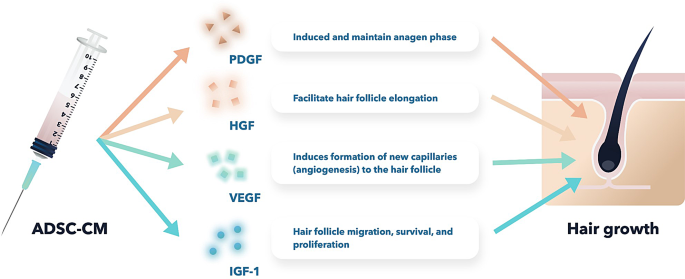
Biologics and immunosuppressants are treatments to control the underlying disease itself. Stem cell conditioned media, delivered to the scalp, acts on the peri-follicular microenvironment and growth-factor signaling — it is not a drug that treats psoriasis or atopic dermatitis as a disease. Scalp treatment under biologics is built strictly on the division of roles: “the primary physician manages the underlying disease, and we run in parallel on the hair domain.” Never reduce or discontinue the oral medication or injections for the underlying disease on your own, as this can trigger a flare.
Sharing Information with the Primary Physician and Our Judgment Framework
What We Always Confirm at the First Visit
For patients on biologics or immunosuppressants, we always confirm five things at the first visit: (1) drug name and dose, (2) dosing cycle and date of the most recent dose, (3) disease activity of the underlying condition, including any scalp lesions, (4) recent infection episodes and any history of herpes zoster, and (5) the primary physician’s name and institution. When possible, we prepare a letter to the primary physician (describing the treatment content, expected degree of small wounds, and the product used) and ask for their view on whether the procedure is appropriate. Scalp treatment under biologics is not “a treatment the patient decides alone” — it moves forward most safely when dermatology, rheumatology, and our clinic share information as a trio.
Design Procedure Intensity to Start from the Minimum
Rather than opening with high-output Morpheus8 or high-density needling from the first session, we start with low intensity and low volume, then adjust the next session while checking the scalp response and the stability of the underlying disease. Rushing to escalate for effect is less useful, over time, than being able to continue treatment without causing infection or eczema flare. This is a principle that applies to conditioned media hair treatment in general, and is worth holding strictly under immunosuppression.
Frequently Asked Questions
Q. Can I receive scalp stem cell conditioned media treatment while on a biologic?
It is not universally contraindicated, but the judgment depends on the drug class, the activity of the underlying disease, and the state of the scalp. After sharing information with the dermatology attending, the baseline is to schedule it when the underlying disease is calm and scalp lesions are not active. Whether it can be done safely in any individual case is decided after examination.
Q. Is there a difference between dupilumab and JAK inhibitors?
As a general rule, dupilumab is regarded as having a relatively limited systemic immunosuppressive effect, while JAK inhibitors are a class where clinicians remain alert to reactivation of herpes zoster and similar events. Even within atopic dermatitis treatment, the background is entirely different, so we adjust procedure intensity and observation frequency according to the primary physician’s view.
Q. Can the procedure be done when there is psoriatic erythema or eczema on the scalp?
As a rule, we do not recommend the procedure while scalp lesions are active. The safer order is to first calm erythema, scale, and eczema with dermatological treatment, and to enter the hair regenerative medicine phase only after the scalp barrier has stabilized.
Q. What should I do if redness or vesicles appear on the scalp after the procedure?
Some reactions are mild and transient and settle on their own, but if you see vesicles, pustules, marked warmth, spreading erythema, or fever, do not wait it out — please contact our clinic or your dermatology attending promptly. Under immunosuppression, early response to infection signs is especially important.
Q. Will stem cell conditioned media improve psoriasis or atopic dermatitis themselves?
The conditioned media delivered to the scalp acts on the peri-follicular microenvironment and is not a drug that treats psoriasis or atopic dermatitis as a disease. Control of the underlying disease remains centered on the dermatology attending’s treatment; think of the hair domain as running alongside it.
──────────────
【監修】森脇 進 / Shin Moriwaki(監修医師)
日本美容外科学会(JSAS)会員 / American Academy of Aesthetic Medicine 会員
ECFMG Certificate
──────────────
📍AVAN TOKYO 銀座 毛髪再生医療
AVAN TOKYO Ginza Hair Regenerative Medicine
English / 中文 / Tiếng Việt available
Inquiries welcome via DM / LINE / Website / Phone.