


Where Does Stem Cell Conditioned Media Hair Therapy Fit Within the ‘Class I / II / III’ Regenerative Medicine Risk Classification? — Dr. Moriwaki on the Class III Regenerative Medicine Literacy to Avoid Confusing ‘Notification’ with ‘Approval’2026.08.13
When patients are told, “Hair therapy using stem cell conditioned media falls under Class III regenerative medicine,” many intuitively assume, “That must mean it is safer than Class I.” However, this risk classification simply indicates the medical-risk level of the cells or conditioned media used—it does not mean that the treatment is guaranteed to be effective, or that every clinic maintains equivalent quality. Understanding the framework of Class III regenerative medicine correctly is critical literacy for patients choosing stem cell conditioned media hair therapy to protect their own safety and informed consent.
Key Points of This Article
・Class III is a category of relatively lower medical risk compared with Class I or II, which involve implanting cells themselves; most stem cell conditioned media hair treatments fall under this class.
・The misconception that “Class III means safety is fully guaranteed” is widespread, but patients must confirm three items: the notified facility, lot management of the manufacturer, and the treatment plan.
・Advertising phrases such as “MHLW-approved” or “government-endorsed” tend to conflate “notification” and “approval”; patients need to read them with the semantic difference in mind.
・This risk classification is a starting point for patients’ own safety judgment, not the finish line.
・Even for stem cell conditioned media hair therapy, receiving a careful physician explanation of indications, limits, and cost is the most important step.
What is the Class III regenerative medicine risk classification?
Japan’s Act on the Safety of Regenerative Medicine categorizes treatments into three tiers based on risk. Class I covers treatments using ES cells, iPS cells, or animal-derived cells. Class II involves administering autologous or allogeneic somatic stem cells into the body. Class III is the framework for treatments that fall outside those tiers. Administration of stem cell conditioned media (not the cells themselves, but the liquid factors secreted into culture medium) is not a cell transplant, and is therefore generally implemented as Class III under notification.
How Do the Three Classes Differ?
Class I involves highly undifferentiated cells such as ES/iPS cells, requiring evaluation of tumorigenic risk and ethical review. Class II involves autologous adipose- or marrow-derived somatic stem cells administered into the knee joint or subcutaneous tissue; because the cells are retained in the body, risks of infection, rejection, and abnormal differentiation are judged to be higher than Class III. Class III is a framework judged to carry lower medical risk than these, and most stem cell conditioned media hair therapies fall here.
Where Does Stem Cell Conditioned Media Hair Therapy Sit?
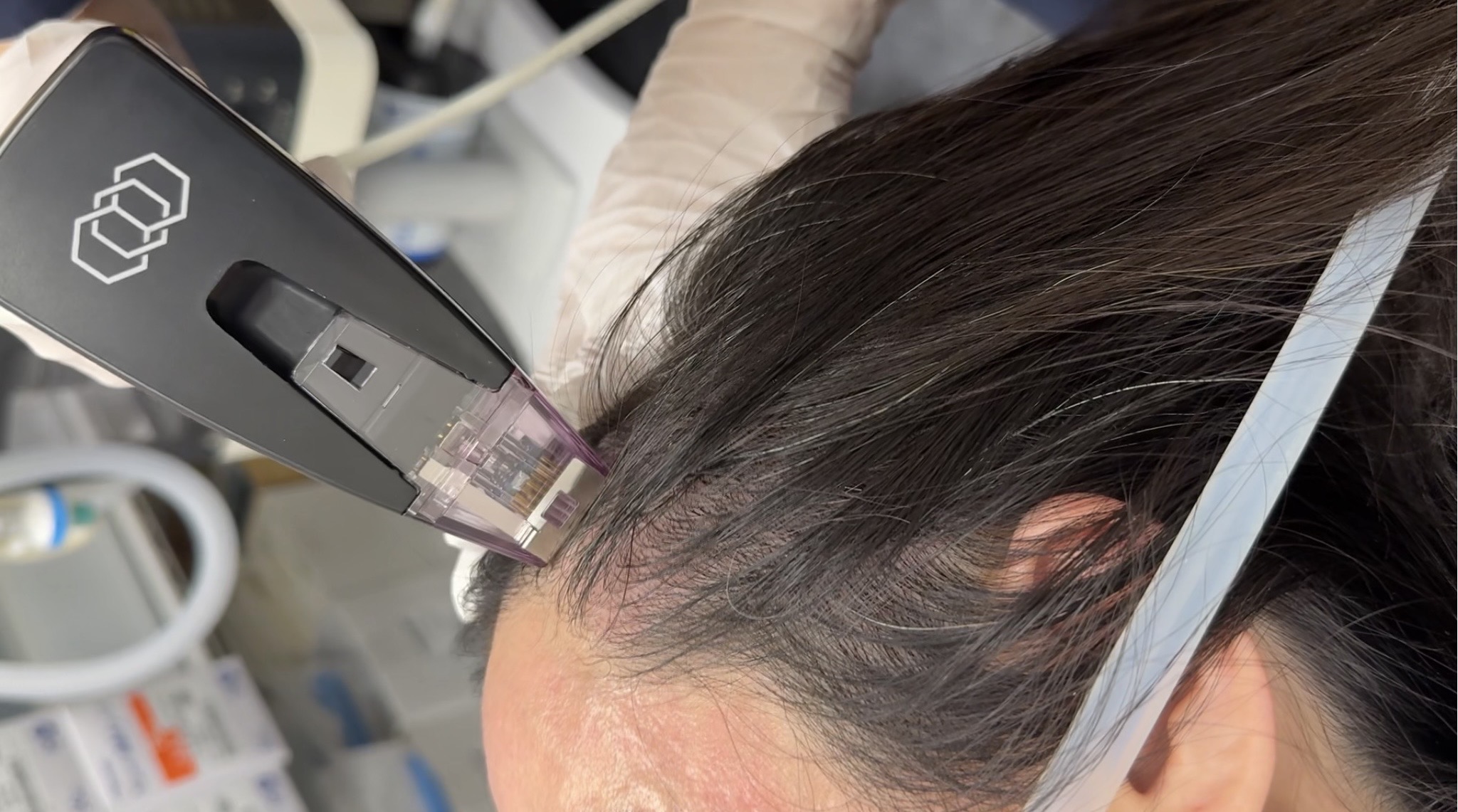
Stem cell conditioned media hair therapy is a treatment design that injects or delivers conditioned media (i.e., cell-secreted, cell-free liquid components) into the scalp. Because cells are not retained in the body, the medical risk is positioned as relatively lower than Class I or II, and it is implemented as Class III under notification. However, “Class III does not equal zero risk” is a point that is easily misunderstood; injection technique, quality of the conditioned media, and the patient’s own constitution remain clinical variables.
Reading “Notification” and “Approval” Without Confusing Them
When choosing Class III regenerative medicine hair therapy, what patients most commonly confuse is the difference between “notification” and “approval.” Although advertising sometimes uses the two with similar resonance, their meanings are entirely different.
“Notification” Is an Administrative Filing of the Treatment Plan
Under the Act on the Safety of Regenerative Medicine, “notification” is an administrative procedure in which the medical institution submits a treatment plan to a Certified Regenerative Medicine Committee, receives its opinion, and then files with the Ministry of Health, Labour and Welfare (MHLW). Once accepted, the clinic may perform the treatment—but notification only demonstrates that the requirements to conduct the treatment have been met. It does not mean the government has guaranteed efficacy. Ongoing compliance—procedure records, adverse-event reporting, periodic reporting—is required after filing.
“Approval” Is a Separate Process Under the PMD Act
“Approval,” on the other hand, is granted by the Minister of Health, Labour and Welfare after the Pharmaceuticals and Medical Devices (PMD) Act’s review of efficacy and safety as a drug, device, or regenerative medical product. Advertising phrases such as “MHLW-approved” or “government-endorsed” sometimes exaggerate a notified status as if it were approved—but these are entirely different processes. Most Class III hair therapies are “notified,” not “approved,” and patients must hold this premise correctly. For how to read pharmacological evidence, refer to guidance from specialist societies such as the Japanese Dermatological Association, and approach advertising language as medical terminology.
Five Checkpoints That “Class III Regenerative Medicine ≠ Safe”
Even if this classification indicates “relatively lower risk,” it does not mean “safety is perfectly guaranteed.” The following five points are what patients should confirm with the clinic.
First, is the clinic registered as a notified facility?—choose one that can present the name of its Certified Regenerative Medicine Committee and the notification number. Second, the conditioned media manufacturer and information on the facility notified for “Specified Cell-Processed Product Manufacturing”—lot-testing regimes for sterility, mycoplasma, and endotoxin determine quality. Third, does the injection protocol follow the treatment plan?—confirm that frequency, interval, and evaluation criteria are stated in advance. Fourth, is there disclosure of side effects and adverse events?—honest explanation of frequency and management for bruising, swelling, allergic reactions, etc., is essential. Fifth, the total picture of cost and follow-up—this treatment is out-of-pocket self-pay, and total estimates (rather than per-session pricing) reveal reality.
Frequently Asked Questions
Q. If it is Class III regenerative medicine, is stem cell conditioned media hair therapy absolutely safe?
“Class III” indicates relatively lower risk—it does not mean safety is perfectly guaranteed. Verify the notified facility, manufacturer, lot testing, and treatment plan, and receive a careful explanation of indications and limits from your physician.
Q. Can I trust advertising that says “MHLW-approved”?
The phrase “MHLW-approved” may be an exaggeration of “notified” status. Class III is a “notification” system, distinct from the “approval” of drugs, devices, or regenerative medical products. Confirm which meaning is intended.
Q. Do Class I and II hair treatments exist?
Injecting autologous adipose-derived stem cells into the scalp may fall under Class II, but hair treatments using stem cell conditioned media itself (a cell-free secretion) are primarily Class III. iPS-cell-derived follicle regeneration is discussed within the Class I framework, but much of it remains at the research stage.
Q. How can patients verify notification content themselves?
The MHLW publicly discloses lists such as the “Directory of Regenerative Medicine Providers,” where notified institutions and treatment plan names can be viewed. During consultation, confirm the notification number and cross-reference public information to independently verify a degree of transparency.
Q. I was told “since it is Class III, you can receive it as many times as you like.” Is that true?
A low risk classification and “unlimited repetition” are separate matters. Administration should follow a treatment plan accounting for the hair cycle, inflammatory response, and cost-effectiveness. Unnecessary repetition may only add tissue burden and financial cost.
The Class III regenerative medicine risk classification is only a starting point for patients to choose stem cell conditioned media hair therapy for themselves. Understanding the classification correctly, confirming three items (notification, manufacturer, treatment plan), and then consulting your physician carefully about indications, limits, and cost is the shortest path to a hair treatment you can accept with peace of mind. For related information, please also see the AVAN TOKYO Ginza Hair Regenerative Medicine column list.
──────────────
Supervising Physician: Shin Moriwaki, MD
Member, Japan Society of Aesthetic Surgery (JSAS) / American Academy of Aesthetic Medicine
ECFMG Certificate
──────────────
📍AVAN TOKYO Ginza Hair Regenerative Medicine
English / 中文 / Tiếng Việt available
Inquiries via DM / LINE / Website / Phone.