


Hair Loss in Endurance Runners and Triathletes: Exercise-Induced Iron Deficiency and Its Impact on Hair Follicles2026.09.24
“My hair started falling out after I started running marathons.” “My hair got thinner once I increased my triathlon training volume.” Behind these complaints from endurance athletes is often a hidden condition: exercise-induced iron deficiency hair loss. Endurance sports drain iron through several routes at once — mechanical destruction of red blood cells by foot strike, heavy sweating, micro-hemorrhage in the gastrointestinal tract — and at the same time inflammatory cytokines raise hepcidin, blocking iron absorption. In this article, supervising physician Dr. Moriwaki explains the link between endurance training and iron metabolism, the role iron plays inside the hair follicle, and how stem cell conditioned media supports the scalp environment as part of the treatment plan.
Key Points
・Exercise-induced iron deficiency hair loss arises when endurance sports create iron loss and impaired iron absorption through multiple simultaneous routes.
・Even without anemia on blood tests, low stored iron (ferritin) is enough to interfere with hair matrix cell division.
・Ribonucleotide reductase, essential for DNA synthesis in hair matrix cells, is iron-dependent, so iron deficiency shortens the anagen phase.
・The first step of treatment is correcting iron nutrition; running stem cell conditioned media in parallel supports the scalp environment.
・Coexisting causes such as androgenetic alopecia and thyroid dysfunction are common, so multi-axis differential diagnosis is essential.
Why Does Exercise-Induced Iron Deficiency Hair Loss Occur?
Iron deficiency in endurance runners and triathletes has long been recognized in sports medicine. Iron demand is higher than in the general population, and multiple mechanisms of loss and impaired absorption overlap, so ordinary dietary intake often cannot keep up.
Foot-Strike Hemolysis and Iron Loss Through Sweat and the Gut
The classic mechanism is “foot-strike hemolysis.” The impact of each stride mechanically destroys red blood cells inside the capillaries of the sole, and some of the iron released from hemoglobin is lost in urine. Iron is also excreted in small amounts in heavy sweat, and long-distance running frequently causes micro-bleeding from ischemia of the gut mucosa. Triathletes carry the combined load of swimming, cycling, and running, so all of these routes can progress in parallel.
Reduced Iron Absorption via Elevated Hepcidin
Another key mechanism is that after exercise the inflammatory cytokine IL-6 rises, driving up hepcidin, the liver peptide that regulates iron metabolism. Hepcidin suppresses intestinal iron absorption and blocks the release of iron from macrophages into the bloodstream. During periods of hard training, hepcidin stays chronically elevated, producing a state where iron cannot be taken up even when consumed in the diet. This is why exercise-induced iron deficiency hair loss shows up as the paradox of “eating enough but still short on iron.”
The Role of Iron in the Hair Follicle
Hair Matrix Cell Division and Iron-Dependent Enzymes
Hair matrix cells are among the fastest-dividing cell populations in the body. Ribonucleotide reductase — the enzyme essential for the DNA synthesis that supports division — carries iron at its catalytic center. When iron runs low, enzyme activity drops, DNA synthesis in matrix cells stalls, and the anagen (growth) phase becomes hard to maintain. The hair cycle then shifts early into telogen, shedding increases, and new hairs come in finer and shorter.
How to Read Ferritin Values
A normal hemoglobin on a blood test is not enough reassurance. If ferritin, which reflects storage iron, is low, iron may be pulled first from “deprioritizable tissues” such as hair and nails, before red cells suffer. When suspecting exercise-induced iron deficiency hair loss, it is common to aim for ferritin above 30 ng/mL, ideally in the 50 – 70 ng/mL range. However, high hepcidin can push ferritin up as an inflammatory marker, so we combine several indicators such as CRP and transferrin saturation for evaluation.
Patterns of Hair Loss Typical in Runners and Triathletes
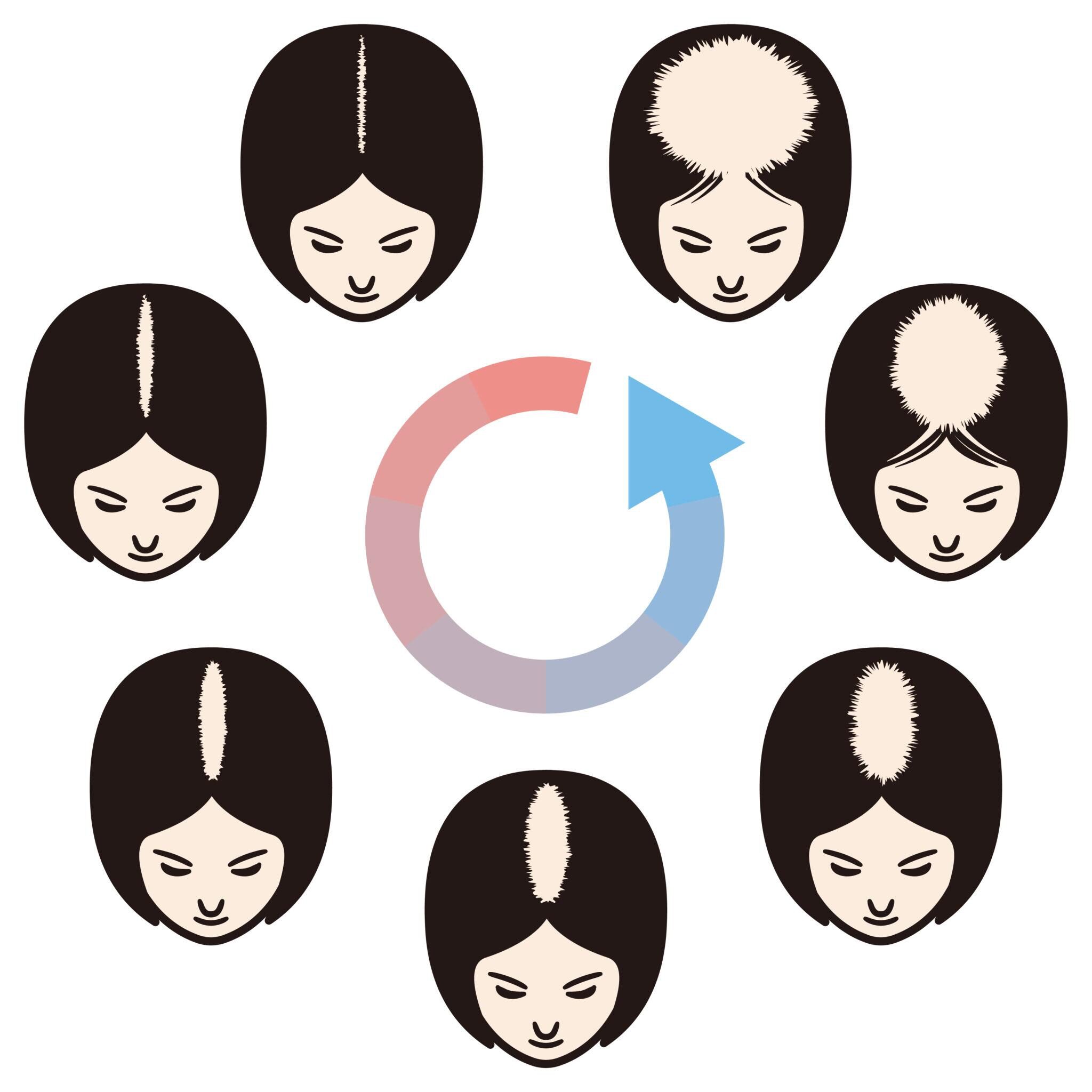
Exercise-induced iron deficiency hair loss is typically a diffuse change — hairs across the whole scalp become finer, and the total bulk when gathered is reduced — rather than a localized loss at the crown or hairline. The part looks wider, the ponytail feels half as thick as before, and shampoo-time shedding is clearly heavier. These signs often appear three to four months after training volume was ramped up, reflecting the hair-cycle time lag. Because the onset of iron deficiency and the awareness of shedding are offset in time, the cause is often hard to notice.
Differentiating from Androgenetic Alopecia
In male runners, androgenetic alopecia (AGA) often progresses in parallel, and iron repletion alone leaves some of the loss unaddressed. AGA is a site-specific alopecia that begins at the frontal and vertex regions, where follicles sensitive to dihydrotestosterone (DHT) gradually miniaturize. When the diffuse changes of exercise-induced iron deficiency hair loss and the localized changes of AGA occur together, iron repletion, anti-androgen therapy, and interventions targeting the follicular environment itself must be combined. See our hair regeneration column index for related reading. Guidelines for AGA treatment from the Japanese Dermatological Association are also a useful reference.
Treatment Plan: Iron Repletion and Stem Cell Conditioned Media in Parallel
First, Correct Iron Nutrition
The first step is to raise storage iron with diet, supplementation, and, when needed, prescription iron under medical supervision. In endurance athletes with elevated hepcidin, alternate-day oral iron is known to be absorbed more efficiently than daily dosing. During periods of extremely high training load, oral iron may not keep up, and intravenous iron under physician management may be considered.
Stem Cell Conditioned Media for the Scalp Environment
After prolonged iron deficiency, the scalp shows persistently thin perifollicular microcirculation and diminished growth factor signaling. Delivering stem cell conditioned media into the scalp via injection or drug delivery raises the environment surrounding the follicles itself. The diverse growth factors in the media — HGF, IGF-1, VEGF, TGF-β and others — support the maintenance of the anagen phase by lifting the dormancy of follicular stem cells, promoting angiogenesis, and remodeling the extracellular matrix. The clinical value is that hair quality and density which iron repletion alone cannot fully restore can be pushed forward on a shortened timeline. That said, as long as the underlying exercise-induced iron deficiency hair loss remains, the anagen phase will not extend, so treatment must always run in parallel with an intervention against the underlying cause.
Frequently Asked Questions
Q. Can iron deficiency affect my hair even if I have never been told I am anemic?
Yes, it can. Even with hemoglobin in the normal range, at the stage of “latent iron deficiency” — low ferritin reflecting low storage iron — the effects appear first in lower-priority tissues such as nails and hair. Exercise-induced iron deficiency hair loss is best understood as an extension of this latent iron deficiency.
Q. Will cutting back training stop the hair loss?
If training volume is excessive, adjusting the load can lower inflammatory cytokines and hepcidin, improve iron absorption, and calm the shedding. That said, with iron repletion, dietary review, and the hair cycle time lag combined, three to six months typically pass before a change is clearly felt.
Q. Do female runners need to be especially careful?
Because iron loss from menstruation stacks on top of exercise-driven loss and impaired absorption, female endurance athletes are considered a high-risk group for iron deficiency. Diffuse shedding and changes in hair texture can appear early, so blood tests including ferritin are recommended early.
Q. Does stem cell conditioned media scalp treatment affect athletic performance?
The stem cell conditioned media used for scalp injection and drug delivery is not a treatment designed to act systemically in large doses. It is not a drug that directly affects performance, but downtime planning immediately before races or during high-intensity training blocks should be discussed in advance.
Q. Once things improve, will the problem come back?
As long as training volume remains high, the balance between iron demand and loss does not change. Regularly monitoring ferritin, diet, and training load and continuing scalp treatment as needed is the realistic way to minimize recurrence.
──────────────
Supervising physician: Shin Moriwaki, MD
Japan Society of Aesthetic Surgery (JSAS) Member / American Academy of Aesthetic Medicine Member
ECFMG Certificate
──────────────
📍AVAN TOKYO Ginza Hair Regenerative Medicine
AVAN TOKYO Ginza Hair Regenerative Medicine
English / 中文 / Tiếng Việt supported
Consultations available via DM / LINE / Website / Phone.