


When you first sense “my hair loss is picking up,” what should be examined before anything else? Dr. Moriwaki organizes a hair loss first-visit workup built from history-taking, family history, and rate of progression2026.08.04
The moment you notice “my hair loss seems to be picking up recently,” jumping straight into “let me try a scalp tonic,” “let me start a hair-growth drug,” or “let me get stem cell conditioned media injected” tends to be the long way around. A hair loss first-visit workup begins, before any treatment, by building an ordered map that separates “what type of hair loss this is, at what speed it is moving, and how far along it has come.” Skip this step and you risk building a therapy on a shaky foundation, or piling a powerful treatment onto a form of hair loss for which it was never indicated in the first place.
Key points of this article
・A hair loss first-visit workup is built in a fixed order: history-taking → inspection and palpation → family history → rate of progression → targeted lab work when needed.
・Before treatment, the top priority is to separate AGA/FAGA, telogen effluvium, cicatricial (scarring) alopecia, and hair loss driven by systemic disease.
・The combination of family history and age of onset is a key input for predicting how quickly things will progress and what the future picture looks like.
・The more clearly you can put “when it started” and “how it has changed” on a timeline, the more precise the treatment design becomes.
・Discussion of stem cell conditioned media or oral medication belongs after the diagnosis has been settled; the more the sequence is skipped, the more waste accumulates.
The first step of a hair loss first-visit workup is history-taking — five axes to ask about
History-taking is not just small talk; it is the foundation that decides everything that follows — inspection, palpation, blood work, and the treatment plan itself. In my view, the single most information-rich part of a hair loss first-visit workup is the 10–15 minutes of history-taking on that very first visit.
When did it start (time of onset)
We pick up the trigger of onset on a timeline: “about a year ago,” “six months after childbirth,” “around when I moved for a job assignment and my environment changed.” The conditions we need to suspect are very different for acute changes versus chronic, slowly creeping ones. As a rule of thumb, a sudden increase in shedding steers us first toward telogen effluvium, drug-induced hair loss, thyroid dysfunction, and iron deficiency, while slow progression steers us first toward AGA/FAGA.
How it has changed (pattern of progression)
Statements such as “the frontal hairline is receding,” “my part is getting wider,” or “there is generally more hair coming out when I shampoo” reflect the type of hair loss. Focal recession points to AGA/FAGA, whereas diffuse shedding across the whole scalp points to telogen effluvium or a systemic driver.
Family history
For both the paternal and maternal side, we ask not only whether relatives are affected but also “from what age” and “how far it advanced,” which gives us a realistic read on the rate of progression.
Past medical history and medications
We map out histories and drugs with any potential link to hair loss: thyroid disease, anemia, connective tissue disease, dermatologic conditions, and drugs such as anticoagulants, steroids, chemotherapy, and hormonal agents.
Life events
Pregnancy, childbirth, large weight fluctuations, extreme dieting, severe psychological stress, and major surgery are classic triggers of telogen effluvium.
What are we actually looking at with inspection, palpation, and trichoscopy?
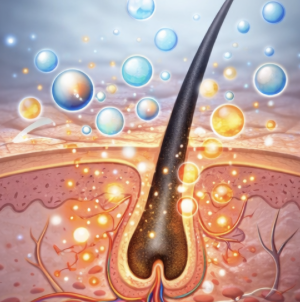
This is the stage where the hypotheses raised in history-taking get cross-checked by the eyes, the hands, and magnified observation. We divide the scalp into frontal, vertex, temporal, and occipital regions and check the variation in hair caliber, the number of hairs per follicular unit, the color of the scalp, the presence of scaling, erythema, or pustules, and the presence of scarring. If a scarring pattern shows loss of follicular ostia, no amount of lifestyle adjustment and no stem cell conditioned media injection will bring the hair back. Ruling that in or out early prevents mismatched expectations later on. Trichoscopy makes visible signs the naked eye cannot capture — hair caliber variation (anisotrichosis) and reduction in hairs per follicular unit seen in AGA/FAGA, exclamation-mark hairs in alopecia areata, or the purple hue of lichen planopilaris.
How do we estimate the rate of progression?
Alopecia cannot be read from a single “now” photo. Together with the patient, we look back at pictures from one, three, and five years ago — driver’s licenses, student IDs, photos left behind on social media — and estimate “how much has been lost per year” by dividing recession over time. Even at the same Norwood III, a patient who arrived there slowly over ten years and one who raced there in two require very different treatment urgencies. The faster the progression, the more we have to load the plan toward “first, stop it,” and the position of stem cell conditioned media in that plan shifts accordingly.
Who needs blood work?
In both men and women, when progression is rapid, the pattern is diffuse, or there is a background of postpartum period, extreme dieting, or chronic fatigue, we consider additional tests such as ferritin, TSH, FT3, FT4, vitamin B12, folate, and zinc. “It’s AGA, so blood work isn’t needed” is an outdated view — with hidden storage-iron depletion or subclinical hypothyroidism running in the background, however strong the treatment plan, hair will keep slipping out from the foundation. Conversely, in a middle-aged man with slowly progressive Norwood III and an obvious family history, mandating a comprehensive panel from the outset is unnecessary; adding tests as the course unfolds is a more realistic operational choice.
Only after the diagnosis is settled do we design treatment
After walking through a hair loss first-visit workup like the one above, concrete plans finally become possible: “AGA/FAGA is the main driver but with a telogen effluvium component mixed in,” “cicatricial alopecia is on the differential, so dermatologic assessment goes first,” or “clear iron deficiency is present, so we run in parallel with internal medicine.” Stem cell conditioned media hair therapy is meaningful in conditions where follicles remain and the main problems are micro-inflammation and miniaturization; it does not work on a scalp where cicatricial alopecia has already erased the follicles themselves. A diagnosis that respects the sequence directly reduces the number of treatments that miss the mark.
The same hair loss can shift its treatment design once the diagnostic basis changes. You can browse related columns at the AVAN TOKYO Ginza hair regenerative medicine column archive. For clinical guidance on AGA and alopecia areata, please also refer to the Japanese Dermatological Association guidelines.
Frequently asked questions
Q. I feel my hair loss has increased, but the amount is still small. Should I come in right away?
The moment you “start to worry” is the best window for consultation, because it is when the most information can still be preserved. Building a hair loss first-visit workup that includes rate of progression while comparison with older photos is still possible speeds up decision-making later. Whether or not to start treatment right away can be decided together with your physician based on the diagnostic result.
Q. What should I bring for the first visit?
Notes covering face photos from the past 1–5 years, a list of current medications and supplements, whether family members have hair loss and at what ages, and health changes in the past six months (childbirth, sharp weight loss, severe stress, major surgery, etc.) let us dig deeper within a limited consultation time.
Q. If I am told I have AGA, do I have to combine stem cell conditioned media?
It is not compulsory. The way oral, topical, and regenerative treatments are combined depends on the degree of progression, age, follicular reserve, and the goal you want to reach that the diagnosis surfaces. Rather than “do everything,” the realistic design is “add what is needed, in order.”
Q. Is blood work required every visit?
We confirm once at the first visit; if there is a significant abnormality in iron, thyroid, or nutrition, we let internal-medicine intervention take the lead and retest based on the clinical course after treatment starts. If there are no abnormalities, repeat measurement at every visit is unnecessary.
Q. What happens if I am told cicatricial alopecia is suspected?
Stem cell conditioned media does not work on areas where the follicles themselves have been lost. We first work with dermatology to prioritize inflammation control and diagnostic confirmation, and shift the treatment focus onto “protecting” the areas that have not yet been lost.
──────────────
[Supervised by] Shin Moriwaki, MD (Supervising Physician)
Member, Japanese Society of Aesthetic Surgery (JSAS) / Member, American Academy of Aesthetic Medicine
ECFMG Certificate
──────────────
📍AVAN TOKYO Ginza Hair Regenerative Medicine
AVAN TOKYO Ginza Hair Regenerative Medicine
English / 中文 / Tiếng Việt available.
Inquiries welcome via DM / LINE / Website / Phone.