


Distinguishing ‘Quadriceps Tendinopathy’ from Patellofemoral Osteoarthritis and Jumper’s Knee — the Pathology of Chronic Pain Concentrated at the SUPERIOR Pole of the Patella, and Where Peritendinous Injection of Stem Cell Conditioned Media Can Modulate the Inflammatory Environment of Tendon Tissue vs. Where It Cannot Reconstruct a Complete Rupture — Dr. Moriwaki Explains2026.08.09
When a knee that has endured jump-based sports, squat-heavy weight training, or repeated stair sprints develops a dull, aching pain that lingers for months along the ‘upper rim’ of the kneecap, one pathology to suspect is quadriceps tendinopathy. Because its symptoms resemble patellofemoral osteoarthritis or jumper’s knee (patellar tendinopathy), it is easily overlooked; dismissed as mere ‘overuse’ and left under load, tendon degeneration progresses and the condition becomes chronic in many cases. In this article, Dr. Moriwaki of AVAN TOKYO Ginza organizes the pathology and differential diagnosis of quadriceps tendinopathy, and honestly outlines what peritendinous injection of stem cell conditioned media can and cannot achieve, staying faithful to both indication and limitation.
Key Points
・Quadriceps tendinopathy is chronic degeneration at the tendon-bone junction (enthesis) of the SUPERIOR pole of the patella, and differs in lesion site from jumper’s knee (patellar tendinopathy), which arises at the INFERIOR pole.
・It is easily confused with intra-articular disease such as patellofemoral osteoarthritis, so identifying the tender point and using MRI/ultrasound to separate tendon degeneration, partial tear, complete tear, and bony deformity is the premise of treatment design.
・What peritendinous injection of stem cell conditioned media can address is ‘modulation of the inflammatory environment around the enthesis’ — it cannot achieve anatomical reconstruction of a complete tear or correction of bony deformity.
・Local steroid injection may relieve short-term pain in some scenarios, but repeated intratendinous administration must be approached cautiously given the risks of tendon weakening and rupture.
・Injection is designed as an adjunct built on top of an eccentric exercise-centered rehabilitation program — pursuing results with injection alone is not the intended approach.
What Is Quadriceps Tendinopathy — Why It Is Nicknamed ‘the Jumper’s Knee ABOVE the Kneecap’
The lesion sits at the tendon-bone junction of the SUPERIOR pole of the patella
The quadriceps tendon is a robust structure formed by the convergence of the rectus femoris, vastus medialis, vastus lateralis, and vastus intermedius, inserting at the superior pole of the patella. In movements where the quadriceps repeats eccentric contraction — jump landings, the bottom of a squat, steep downhill running — high tensile stress concentrates on this tendon-bone junction (enthesis). As chronic micro-injuries accumulate, collagen alignment within the tendon becomes disorganized and abnormal neurovascular ingrowth develops, shifting the tissue toward ‘tendinosis.’ This is the core pathology of quadriceps tendinopathy, and it must be understood not as simple ‘inflammation’ but as a qualitative change of the tissue itself.
Differentiating from jumper’s knee (patellar tendinopathy)
What is generally called ‘jumper’s knee’ refers to patellar tendinopathy — degeneration at the patellar tendon attachment running from the INFERIOR pole of the patella toward the tibial tuberosity. Quadriceps tendinopathy, by contrast, is located at the SUPERIOR pole, with pain centered on the ‘upper rim of the kneecap.’ Both are prone to arise in the same jump-based sports and are easily conflated, but tender point, ultrasound, and MRI reveal clearly different lesion sites. The first step of diagnosis is to precisely establish by palpation ‘which tendon attachment is painful’ — skip this and the therapeutic target remains ill-defined.
Differentiating from patellofemoral osteoarthritis
Patellofemoral osteoarthritis is intra-articular cartilage degeneration and synovitis between the patella and the femoral trochlea, producing a diffuse ache across the anterior knee with stair climbing or prolonged knee flexion. Quadriceps tendinopathy is distinguished by ‘localized tenderness reproduced by pressing the superior pole of the patella,’ and when plain X-ray or MRI shows joint space narrowing or subchondral bone change, coexistence of osteoarthritis is also assessed. For general information on joint disease, please also refer to the public information of the Japanese Orthopaedic Association.
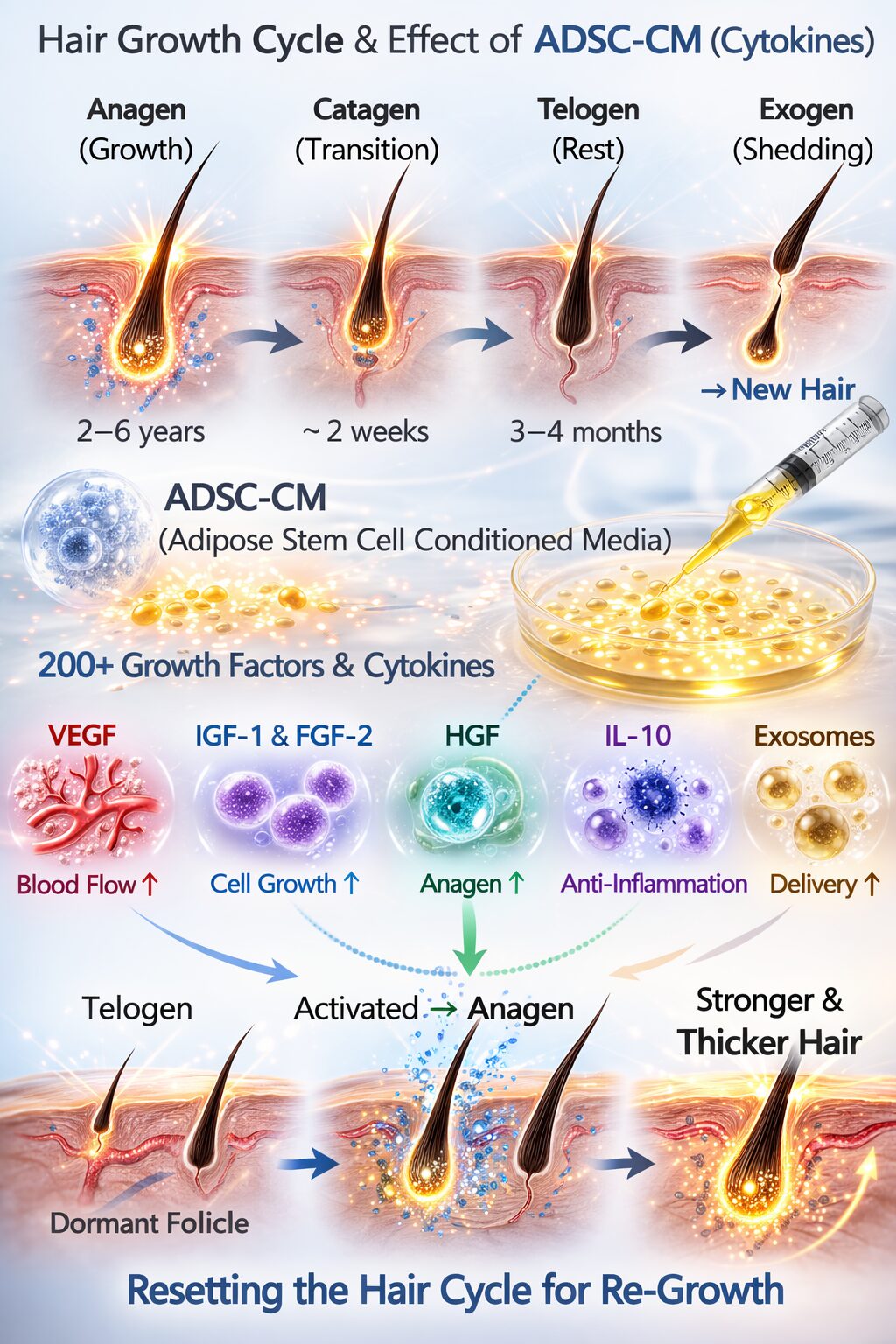
What Peritendinous Injection of Stem Cell Conditioned Media Can and Cannot Address
What it can address — modulation of the inflammatory environment around the enthesis
Chronic pain in tendinopathy is thought to involve a persistent inflammatory cycle in and around the tendon tissue (prolonged inflammatory cytokines such as IL-1β and TNF-α) and elongation of pain-related nerve fibers accompanying abnormal microvascular ingrowth. Growth factors (TGF-β, IGF-1, FGF, VEGF, etc.) and miRNAs contained in stem cell conditioned media have been suggested at the basic research level to potentially calm this inflammatory environment and steer tenocyte metabolism toward repair. Clinically, however, its position is ‘creating an environment where the inflammation/pain baseline is lowered while eccentric exercise drives tendon remodeling’ — no definitive efficacy guarantee can be made. Responses vary individually depending on the degree of tendon degeneration, age, and activity level.
What it cannot address — anatomical reconstruction of complete rupture and correction of bony deformity
When there is complete rupture of the quadriceps tendon or extensive partial tear with functional deficit, injection of stem cell conditioned media cannot anatomically reconstruct tendon continuity itself. This falls within the indication for orthopedic surgical repair. Likewise, osteophyte formation at the superior pole of the patella or bony deformity of the patellofemoral joint cannot be corrected by injection. Using imaging and functional evaluation first to distinguish ‘a stage where injection prepares the environment’ from ‘a stage where surgical intervention takes priority’ is important for both safety and efficacy.
Positioning against local steroid injection
Local steroid injection for chronic pain at a tendon attachment may relieve short-term pain in some scenarios, while repeated intratendinous administration is flagged for concerns of tendon weakening and rupture risk, and is not suited as a repeat baseline. Peritendinous injection of stem cell conditioned media is not so much ‘strongly suppressing inflammation’ as ‘potentially steering the inflammation and repair environments in a favorable direction’ — the intent differs fundamentally from steroids. For further details, please see this page on stem cell conditioned media joint injection.
The Practical Design of Treatment — Injection Does Not Complete It Alone
Eccentric exercise is the foundation
The conservative treatment of tendinopathy centers on tendon remodeling through eccentric exercise (such as decline squats). Injection is positioned as ‘creating an environment during the period when pain blocks exercise therapy’; high-load jump activity is avoided for roughly 2 weeks after injection, and load is stepped back up as pain diminishes. A design that repeats injections without exercise therapy as the foundation is not recommended, as it seldom leads to fundamental tendon remodeling.
Correcting alignment and usage patterns
Lower-limb alignment factors that concentrate tensile stress on the tendon at the superior pole — increased Q-angle, weakness of the vastus medialis obliquus (VMO), foot overpronation — are evaluated and addressed in parallel with orthotic prescription and training guidance. Chasing only tissue repair while leaving form and landing patterns uncorrected simply invites recurrence as long as the load source remains.
Efficacy judgment and continuation decisions
At 4–8 weeks after the first injection, pain scores (VAS) and functional scores (tendinopathy-specific scales) are used for objective assessment; if clear improvement is lacking, we switch to additional dosing, treatment change, or orthopedic re-evaluation. Because the reasons for a poor response are diverse — reconsideration of the diagnosis itself, alignment factors, excessive activity load — simply increasing the number of injections is not the chosen path.
Frequently Asked Questions
Q. Are quadriceps tendinopathy and jumper’s knee the same thing?
Broadly, both are jump-related tendinopathies of the knee, but the lesion sites differ. Jumper’s knee in the narrow sense refers to patellar tendinopathy from the inferior pole of the patella to the tibial tuberosity, whereas quadriceps tendinopathy refers to degeneration at the attachment of the quadriceps tendon at the superior pole. They are clearly distinguished by tender point and MRI findings, and the target site of treatment also differs.
Q. Will one injection cure it?
Complete resolution of chronic tendon degeneration with a single injection is not typically assumed. In most cases, multiple administrations at intervals of weeks to months are considered while monitoring the response to the first injection, and they are combined with eccentric-exercise-centered rehabilitation. Responses vary individually, and improvement tends to be slower in cases where tendon degeneration has progressed.
Q. When can I return to sport after injection?
High-load jumping, sprinting, and heavy squats are avoided for roughly 2 weeks after injection, and load is stepped back up while checking for pain reproduction. Timing for a full return to competition should be judged individually based on the tendon’s response and functional evaluation; a one-size-fits-all timeline is difficult to set.
Q. What is the difference from a steroid injection?
Steroids can more easily remove short-term pain through their strong anti-inflammatory action, but repeated administration into tendon tissue carries reported risks of tendon weakening and rupture. Peritendinous injection of stem cell conditioned media aims not so much at ‘strongly suppressing inflammation’ as at ‘balancing the inflammation and repair environments,’ so the direction of intent differs.
Q. When is surgery required?
Complete rupture of the quadriceps tendon, or extensive partial tear with clear functional deficit, falls within the indication for surgical repair. In addition, when conservative treatment has been given sufficiently for a period of time yet improvement remains poor and daily life or competition remains significantly impaired, surgical options are considered in cooperation with orthopedic specialists.
──────────────
Supervising Physician: Shin Moriwaki, MD
Member, Japan Society of Aesthetic Surgery (JSAS) / Member, American Academy of Aesthetic Medicine
ECFMG Certificate holder
──────────────
📍AVAN TOKYO 銀座 再生医療
AVAN TOKYO Ginza Regenerative Medicine
English / 中文 / Tiếng Việt available
Inquiries via DM / LINE / Website / Phone.