


Decoding “Government-Approved” Ads in Hair Regeneration — What “Notification” and “Approval” Really Mean for Stem Cell Conditioned Media2026.07.03
“Government-approved regenerative medicine” or “nationally recognized cutting-edge therapy” — have you ever seen these phrases in advertisements for hair regeneration or thinning-hair clinics? They sound reassuring, but there is an important distinction that patients should read correctly as a matter of medical advertising literacy. In the field of scalp treatment using stem cell conditioned media, understanding the difference between “notification” and “approval” can dramatically change the accuracy of your treatment choice.
At AVAN TOKYO Ginza Hair Regenerative Medicine, we place strong emphasis on separating advertising claims from regulatory reality, so that patients can make treatment decisions based on their own judgment. In this article, we clarify what the phrase “government-approved” actually refers to in the context of stem cell conditioned media, from the perspective of Japan’s medical advertising guidelines and the Act on the Safety of Regenerative Medicine.
What “Government-Approved” Does Not Mean
First, as a premise, stem cell conditioned media is currently NOT a product “approved” by the Ministry of Health, Labour and Welfare (MHLW) as a “pharmaceutical.” Drug approval refers to a process in which the government reviews clinical trial data on efficacy and safety and formally recognizes indications for use. Pharmaceuticals used in AGA treatment, such as topical minoxidil and oral finasteride, have received this type of approval.
Conditioned media itself, however, is not classified as a pharmaceutical under the Pharmaceuticals and Medical Devices Act. It is a secreted substance obtained during cell culture — a mixture of cytokines, growth factors, exosomes and more. It therefore does not fall into the “approved drug” category. When the phrase “government-approved” appears in ads, what is actually being referred to is, in many cases, a “notification under the Act on the Safety of Regenerative Medicine.”
“Notification” and “Approval” Are Institutionally Different
Under the Act on the Safety of Regenerative Medicine, medical institutions that provide regenerative-medicine technologies including stem cell conditioned media must submit a “provision plan” to the government in advance and have it accepted. This is a “notification,” not an “approval by which the government guarantees the efficacy of an individual therapy.” The notification is a procedure to declare that certain safety-management systems and informed-consent processes are properly in place.
In other words, “notification submitted” proves that a facility has a framework to provide treatment in line with the regulatory system — it is not proof that “the government has recognized this conditioned media as effective for hair regrowth.” This distinction is information that should be shared honestly with patients.
How to Read Confusing Expressions in Advertising
Japan’s medical advertising guidelines discourage expressions such as “government-approved” or “nationally recognized advanced therapy,” because they can mislead patients. Nevertheless, such phrases still appear on websites and social media. One reason is a linguistic drift, where the fact of “having submitted a notification” is rewritten with the connotation of “approval.” Another is the gap that easily emerges between the marketing image of conditioned media as “cutting-edge” and the strict definitions used in regulatory language.
Four Points Patients Can Check
When choosing a clinic that handles stem cell conditioned media, checking the following points helps you avoid being swept along by advertising language. First, whether the facility has submitted a Class 2 or Class 3 regenerative-medicine provision plan. Second, whether the cell source of the conditioned media (umbilical cord-derived, adipose-derived, dental pulp-derived, etc.) and its manufacturer are clearly disclosed. Third, whether the per-lot inspection system (sterility, mycoplasma, endotoxin testing) is made public. Fourth, whether the physician honestly explains both expected effects and limitations.
Instead of pharmaceutical “approval,” these criteria provide realistic indicators for assessing the quality and integrity of a treatment. Judgment should be based on the granularity of information disclosure, not on the flashiness of marketing copy.
Realistic Expectations When Choosing Stem Cell Conditioned Media for Hair Regeneration
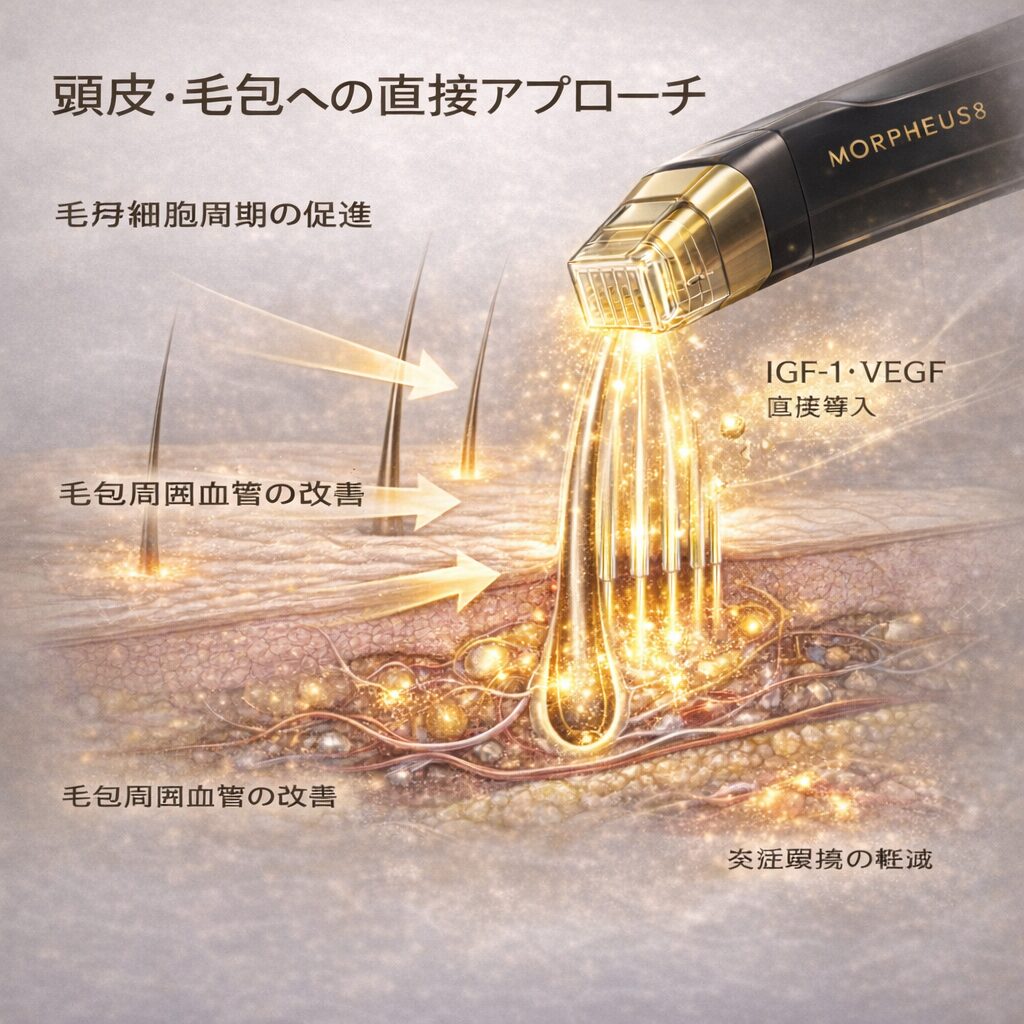
Stem cell conditioned media is an approach that acts on the peri-follicular environment of the scalp by delivering growth factors and exosome-derived signals. Its mechanism of action is different from finasteride or minoxidil, so it is positioned as a complementary option for cases that do not respond well to oral medication, or for patients who are concerned about the side effects of internal drugs. However, strong claims such as “you will definitely regrow hair” or “backed by the government” have weak medical and regulatory grounds.
Current hair regenerative medicine is at a stage of exploring the optimal solution for each patient by combining oral drugs, topical drugs and regenerative approaches, according to progression and constitution. Stem cell conditioned media is one important piece of this puzzle, but honestly acknowledging that it is not an “approved drug,” and clarifying what it can and cannot do, is the path toward treatment without regret.
For guidelines and standard therapy for AGA, the guidelines of the Japanese Dermatological Association are also a useful reference. Please also see our list of related columns on hair regenerative medicine to gather information that fits your situation.
Summary: Choose Based on Regulation and Transparency, Not Flashy Words
The advertising phrase “government-approved” often actually refers to a “notification” under the Act on the Safety of Regenerative Medicine — stem cell conditioned media itself is not “approved” as a pharmaceutical. Simply knowing this distinction significantly sharpens the resolution of your treatment selection.
What matters is correctly understanding the regulatory position, then aligning the facility’s information disclosure, the physician’s explanatory attitude, and your own expectations before deciding. Using “whether a notification has been submitted” and “transparency of information” as decision criteria — rather than flashy catchphrases — is the first step toward a lasting relationship with hair regenerative medicine that uses stem cell conditioned media.
──────────────
Medical Supervisor: Shin Moriwaki, MD
Member of the Japan Society of Aesthetic Surgery (JSAS) / Member of the American Academy of Aesthetic Medicine
ECFMG Certificate
──────────────
📍AVAN TOKYO 銀座 毛髪再生医療
AVAN TOKYO Ginza Hair Regenerative Medicine
English / 中文 / Tiếng Việt supported
For consultation, please contact us via DM / LINE / Website / Phone.